Most investors do not lose to a shortage of information. They lose to the sprawl of it. Quotes live on one site, filings on another, charts somewhere else, and the portfolio sits in a brokerage app that barely talks to any of it. GNG Research is built to close that gap by folding research, screening, proprietary scoring, portfolio tracking, forecasting, and an AI research assistant into one platform that covers more than 4,500 companies.
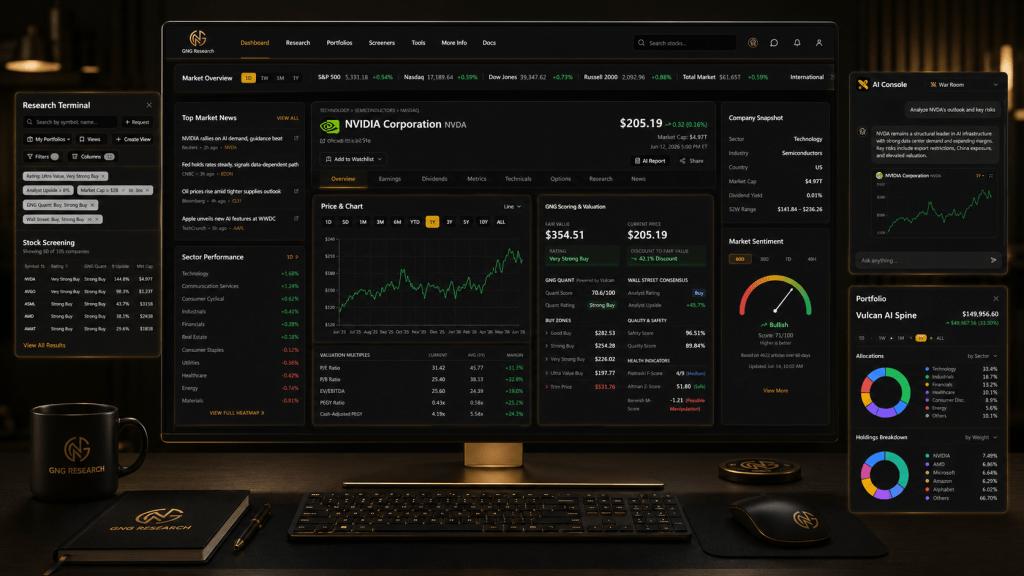
The short version: it fits active investors, long-term stock pickers, dividend investors, and anyone who wants a structured research process without building a spreadsheet stack from scratch. It is not a magic stock picker, because no platform is. What it does well is hand you a clearer, repeatable framework for comparing companies, checking valuation, tracking holdings, and thinking through risk.
I worked through the major sections and checked the claims against the live platform. Here is the honest rundown, including where it comes up short.
What is GNG Research
An independent equity research and investing-tools platform, GNG organizes around three jobs investors actually do. Finding and vetting stocks. Understanding and stress-testing a portfolio. Testing ideas before committing capital. Most tools handle one of those well and leave you to stitch the rest together elsewhere, which is the exact friction GNG is trying to remove.
The appeal is continuity. You can screen for a quality threshold, click into the company page, read the analysis, check the valuation verdict, and then ask how the name fits the portfolio you already hold, all without leaving the site. For investors who prefer deciding from a full picture rather than one headline or one chart, that flow is the draw.
Research and analyst content
One of the stronger pieces is the written research. The analyst desk publishes deep-dives and market commentary that go past surface-level stock blurbs, and the better articles get into portfolio construction, hedging, beta exposure, implied versus realized volatility, and options strategy. That is useful, because many retail sites stop at basic ratios or recycled news.
The tone leans educational rather than promotional, which builds trust. A piece on hedging a book with index puts, for instance, walks through how beta affects hedge sizing and why the choice of instrument and the price of volatility change the cost of protection. Content like that helps you think in portfolio terms instead of one stock at a time.
Stock pages and the scoring system
Type a name like NVDA into the terminal and the first thing you notice is the verdict layer sitting on top of the raw figures. GNG Research runs proprietary Safety, Quality, and valuation scores, a composite Quant rating, fair value estimates, and a ladder of buy-price tiers that descends from a first nibble down to a deep-value level. The single most useful element is the valuation rating, a composite call that lands on a scale from strong buy to strong sell and updates daily.
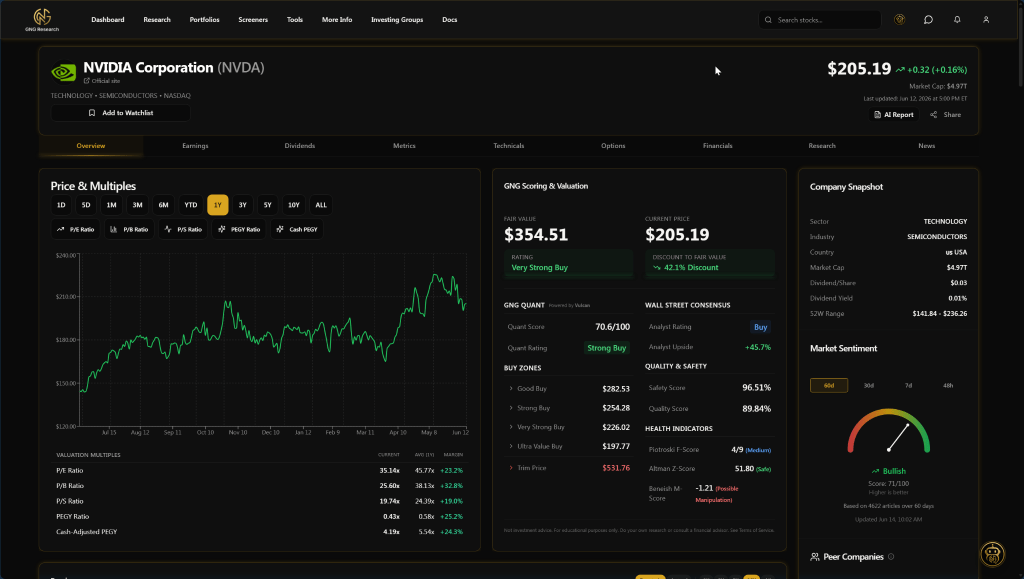
The smarter design choice is that no single metric runs the show. A cheap stock can be cheap for a reason, a fast grower can still be priced for fantasy, and a fortress balance sheet can sit on dead money. By spreading the verdict across valuation, quality, safety, growth, momentum, and sentiment, the system pushes you to look at a company through several lenses at once. When the lenses agree, the idea is likely stronger. When they conflict, the disagreement tells you where to dig.
Screener and stock discovery
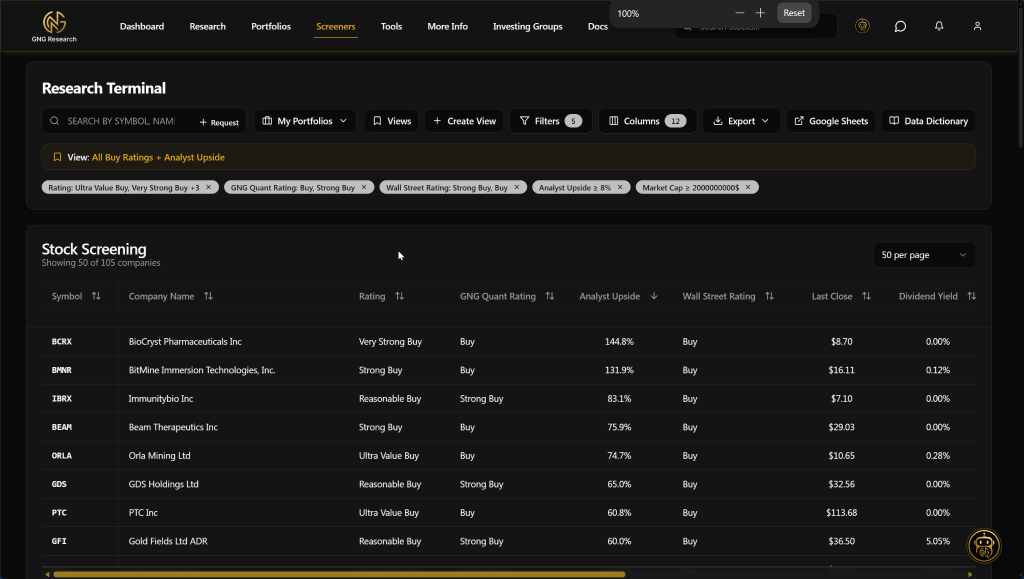
A screener is only as good as its filters and the data behind them. GNG lets you sift the universe by more than 300 metrics, and because the screener ties into the same company pages and scoring framework, discovery flows straight into research. Pull up (MSFT) against a peer set and the screen stops being a list and becomes a comparison.
That continuity matters more than the raw filter count. Screening on one platform and then re-researching every result somewhere else is how good ideas die of friction. Keeping the path from filter to fair value to portfolio fit in one place is the practical advantage here.
Portfolio tracking
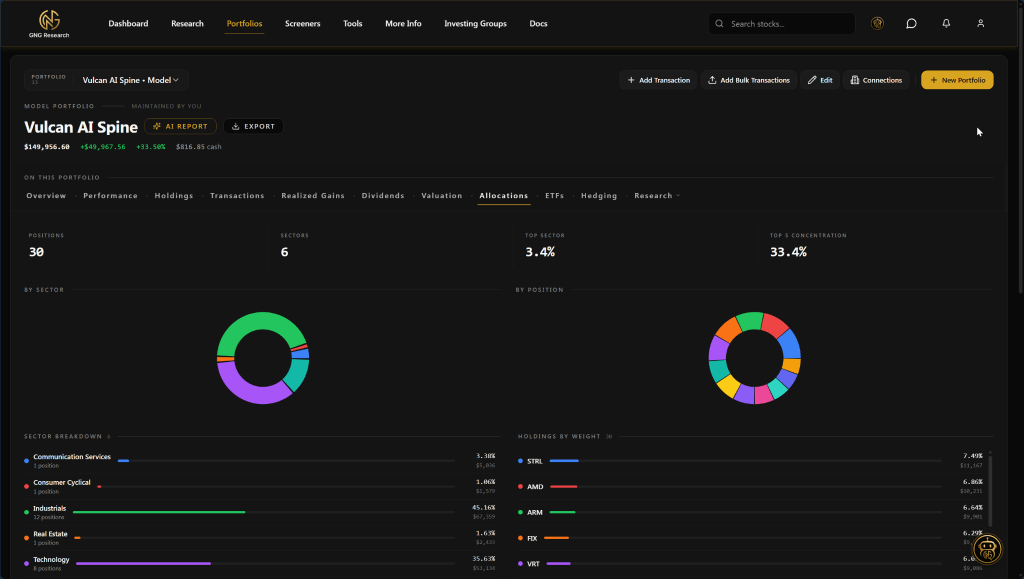
The portfolio tools are where the platform earns its keep for people who already hold positions. You can enter holdings by hand, shadow model portfolios, or connect a brokerage to work on real cost basis and transactions. The tracker surfaces time-weighted and simple returns, benchmark comparisons against the broad market, ETF look-through so you can see overlap you did not know you had, realized gains by tax lot, a dividend calendar, and blended fair-value reads across the book.
The real value is not seeing holdings in one place. It is connecting what you own to research, scoring, and risk, so the tracker can answer the questions that move the needle. Where am I concentrated, which positions carry the risk, and which names deserve a second look. A broker portfolio page rarely gets you there.
The AI research console
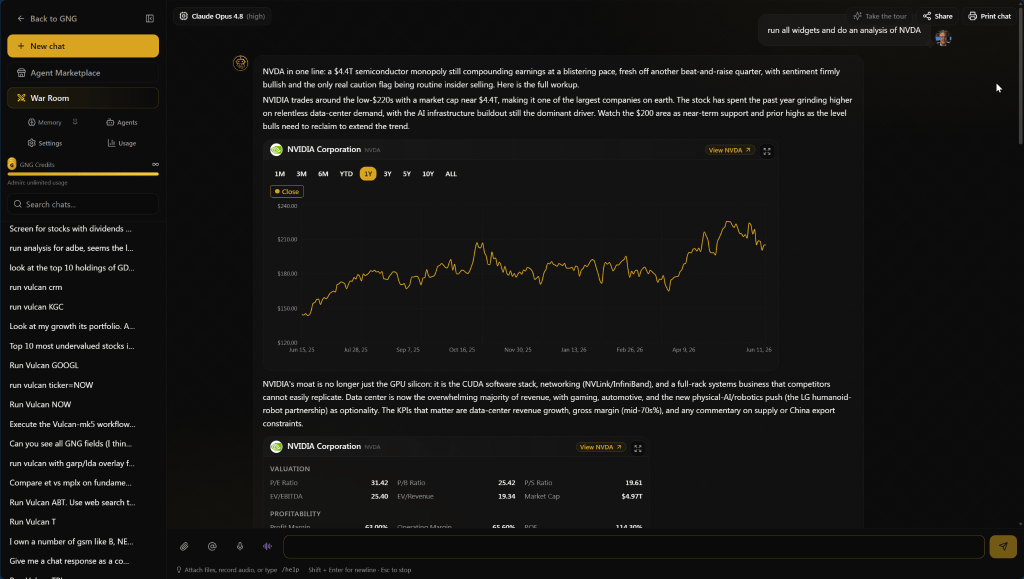
The newest addition is the AI research console, and it is the feature that pushes GNG past a tidy dashboard. Most chatbots bolted onto finance sites summarize news and stop. This one is portfolio-aware and built to run the actual workflow, handing tasks to specialist sub-agents that open the screener, run the backtester, simulate a path, and then show the chart it built and the math behind the answer.
 The AI console runs real screens and simulations, then shows its work rather than handing back a tidy summary. Source: GNG Research
You ask in plain English, and it reaches the same data and tools you would otherwise open in separate tabs, explaining its findings against live fundamentals, dividend history, earnings, and more. It remembers what you care about across sessions, ingests your own PDFs and notes, and lets you spin up focused assistants for income, momentum, or retirement questions. For an investor who knows what to ask, that is genuine workflow compression, and for a newer one it doubles as a patient explainer. The honest framing is that it accelerates research rather than replacing judgment, which is the right way to use any AI in investing.
Forecasting, backtesting, and scenario tools
For investors who like to quantify risk and history, GNG brings several institutional-style tools to the retail level. A backtester runs a strategy across historical conditions. Monte Carlo simulations help you think in ranges instead of single-point guesses. A dividend forecaster serves income investors who care about the next decade rather than today’s yield, and the options tools help size hedges and defined-risk trades.
The strength is that these complement each other. A tactical investor leans on the backtester, an income investor on the dividend suite, a risk-focused one on Monte Carlo, and a portfolio builder uses all three together. That is the difference between a research site and a working analysis bench.
Data accuracy and where it falls short
GNG is reasonably transparent about its data. Fundamentals refresh once daily while intraday prices update through the session, so during a fast move a company page can trail the live tape. Confirm price before acting on anything time-sensitive, and treat the scores as a day-grained read.
A score is a starting point, never the thesis. A composite verdict cannot know your time horizon, your tax situation, or the specific reason a stock looks cheap, so it should point you toward work rather than stand in for it. Lean on it as a filter and a flag.
Backtests and simulations also invite false precision, which is the trap that catches confident people. A clean equity curve and a tidy probability fan feel like certainty, but markets shift regimes and in-sample results flatter the strategy that produced them. Read every projection as a range of maybes.
Two more practical notes. The deepest tools sit behind a paywall, so the free tier is genuinely usable for screening, tracking, and reading the analyst desk, but the full forecasting suite and the heaviest AI work are premium, and you should decide whether that layer matches how you invest before depending on it. And the AI is only as sharp as your questions and your judgment, because a vague prompt buys a confident-sounding vague answer. The platform is upfront that all of this is educational tooling rather than personalized advice, and its ratings are model outputs that carry the usual lag and limits.
Who it is for
GNG is a strong fit for long-term investors who want to compare companies by quality, safety, and valuation, dividend investors who care about income forecasting, active investors who want screeners and commentary in one place, and options-aware investors who want better context around hedging and risk. DIY investors who want structure without handing decisions to a robo-advisor will get the most out of it.
It is less useful if you only buy broad index funds and never research a single name, and it is probably too much if you just want a simple app to check prices. The practical move for everyone else is to start free, build a watchlist, run a few screens, pull up names like (COST) or (V) to learn how the scores read against companies you already understand, then track your real holdings for a month before deciding whether the premium layer earns the upgrade.
Final verdict
The best way to describe GNG Research is that it is a research workspace rather than a stock-idea site dressed up with charts. Its main advantage is pulling together workflows that are usually scattered across different tools, and its standout pieces, the AI console and the daily valuation verdict, are genuinely ahead of much of the field. The reason to use it has little to do with the feature list itself. It comes down to one consistent workspace making a disciplined, repeatable process the easy thing to do, and discipline is where retail returns are won or lost.
For investors who want deeper analysis, clearer portfolio visibility, and tools that connect the dots, GNG Research is worth a close look.
Rating: 4.8 out of 5 Best for: active DIY investors, dividend investors, stock researchers, and anyone who wants portfolio-level tools. Not best for: investors who only need a basic quote app, or who do not want to learn research tools.
At a glance
| Capability | What it does | Tier |
|---|---|---|
| Stock universe | Research and screen 4,500+ companies | Free |
| Screener | Filter by 300+ fundamental and technical metrics | Free |
| Proprietary scores | Safety, Quality, valuation rating, Quant composite, fair value, buy-price tiers | Free |
| Analyst desk | Written deep-dives plus portfolio-level commentary | Free |
| Portfolio tracker | Manual, model, or brokerage-connected; returns, look-through, tax lots, dividend calendar | Free core, advanced in premium |
| AI research console | Portfolio-aware assistant that runs screens, backtests, and sims and shows its work | Free to start, depth in premium |
| Forecasting suite | Backtester, Monte Carlo, dividend forecaster, options tools | Premium |
| Data refresh | Fundamentals daily, prices intraday | Both |
Sources and disclosures
Platform capabilities verified against the official GNG Research site (gngresearch.com) and product documentation (docs.gngresearch.com), June 2026. Specific subscription pricing was not confirmed from a primary source at the time of writing and is intentionally omitted.
Disclosure: Vulcan Stock Research operates under the GNG Research brand, and the author holds an equity interest in GNG Research. This review reflects an affiliated perspective. It is provided for educational purposes only and is not financial advice. Platform ratings and forecasts referenced here are model outputs, not recommendations. Always do your own research before making investment decisions.

 Vulcan Stock Research
Leave a comment