
Stand inside a building when the ground starts to move and every nerve tells you to get out. The walls groan, the light fixtures swing, the glass rattles in its frame. (INTU) has handed its shareholders that exact sensation over the past twelve months. A stock that traded above $800 within the past year now changes hands near $331, nearly 60% below its 52-week high and down roughly 56% over the trailing year. Its 200-day moving average sits up at $554 and slopes down. Momentum has been brutal. If you only watched the chart, you would assume the structure was condemned.
But shaking is not the same as collapse. A structural engineer does not run when the seismograph spikes. They walk the building, check the foundation, test the load-bearing walls, and look for cracks that actually threaten the frame versus cosmetic ones that scare tenants. That is the job here. The market has shaken (INTU) hard. What pays is figuring out whether the structure underneath is sound or genuinely compromised.
Recommendation
Strong Buy, staged. This is a valuation reset, not a momentum buy, so the right move is to build the position in tranches rather than swing at it all at once. Start a partial position near $331, add on a defended retest of the low $300s, and commit the final tranche only after the chart reclaims the mid-$360s and then the $385 to $405 zone. Blended fair value sits near $480, the twelve-month target is $430, and the margin of safety to fair value runs about 31%. Position sizing fits the 1% to 2% individual-name cap, scaled up across the staged adds.
What the market thinks it saw
The selloff was not random. After the quarter reported in May, investors fixated on three things. TurboTax growth came in softer than the bulls wanted, rising 7% to about $4.4 billion. General-purpose AI tools raised a real fear that assisted tax prep loses pricing power over time. And management announced a 17% workforce reduction with $300 million to $340 million of restructuring charges, which always carries execution risk. None of these are imaginary. A consumer franchise that has minted recurring economics for two decades deserves scrutiny the moment its pricing power looks even slightly less bulletproof.
So the tenants panicked and the appraisal cratered. (INTU) now trades as if the foundation has already failed. That gap, between a shaken price and an intact structure, is where the opportunity lives.
Walk the foundation
Start where engineers start, at the base. (INTU) generated about $7.7 billion of free cash flow over the trailing twelve months on $20.9 billion of revenue, an FCF margin near 37%. Gross margin sits around 80%. Net margin runs near 22%. Return on invested capital is in the high teens on a reported basis and roughly 35% on a cash basis. The balance sheet is clean: net debt runs under 0.1x equity, interest coverage clears 15 times comfortably, the Altman Z-score is 4.93, and the Piotroski F-score is a perfect 9. A Beneish M-score of -2.44 shows no signs of earnings manipulation. This is a foundation poured in concrete, not sand.
Now the load-bearing walls, the segments that actually hold the company up. Global Business Solutions, anchored by QuickBooks, grew 15% last quarter, with its Online Ecosystem piece up 19%. Credit Karma grew 15%. Consumer grew 8%. These are the structural supports, and they are carrying weight. QuickBooks in particular is the wall I trust most. Small businesses build payroll, payments, invoicing, and years of financial history on top of it, and they do not casually rip that out. Embedded software like that bends under competitive pressure far more than it breaks.
Guidance reinforces the read. Management raised fiscal 2026 revenue guidance to between $21.341 billion and $21.374 billion, growth of about 13% to 14%, with non-GAAP earnings per share now guided to grow roughly 18%. A company guiding double-digit top-line growth and high-teens earnings growth has not entered freefall. It took a hard jolt, and the frame held.
Find the real crack
Here is the genuine fault line: TurboTax at the low end. Management conceded it lost share among price-sensitive DIY filers, and that is precisely where free or near-free AI guidance can chip away. If basic tax help becomes a commodity, the bottom rung of the TurboTax ladder loses value, and the franchise may eventually deserve a structurally lower multiple than it once commanded.
That crack is real, but it stays localized. Filing taxes still requires accuracy, document import, state returns, audit protection, and a return that actually gets accepted. The assisted and live tiers, where customers pay for confidence rather than convenience, are a different product than the free DIY rung that AI threatens first. Picture one cracked room on an upper floor, not a fracture at the base. Yet the market is pricing it as if it were both.
The workforce cut reads the same way once you look closely. It is frightening on the surface and easy to interpret as distress. Read as a retrofit, it looks more like reinforcement: simplify the organization, cut overlapping work, and redirect capital toward AI and the higher-growth segments at exactly the moment speed matters most. Retrofits can go wrong if the contractor is sloppy. Done right, they make the structure stronger and faster. Two quarters from now we will know which version this is.
Why the price math works
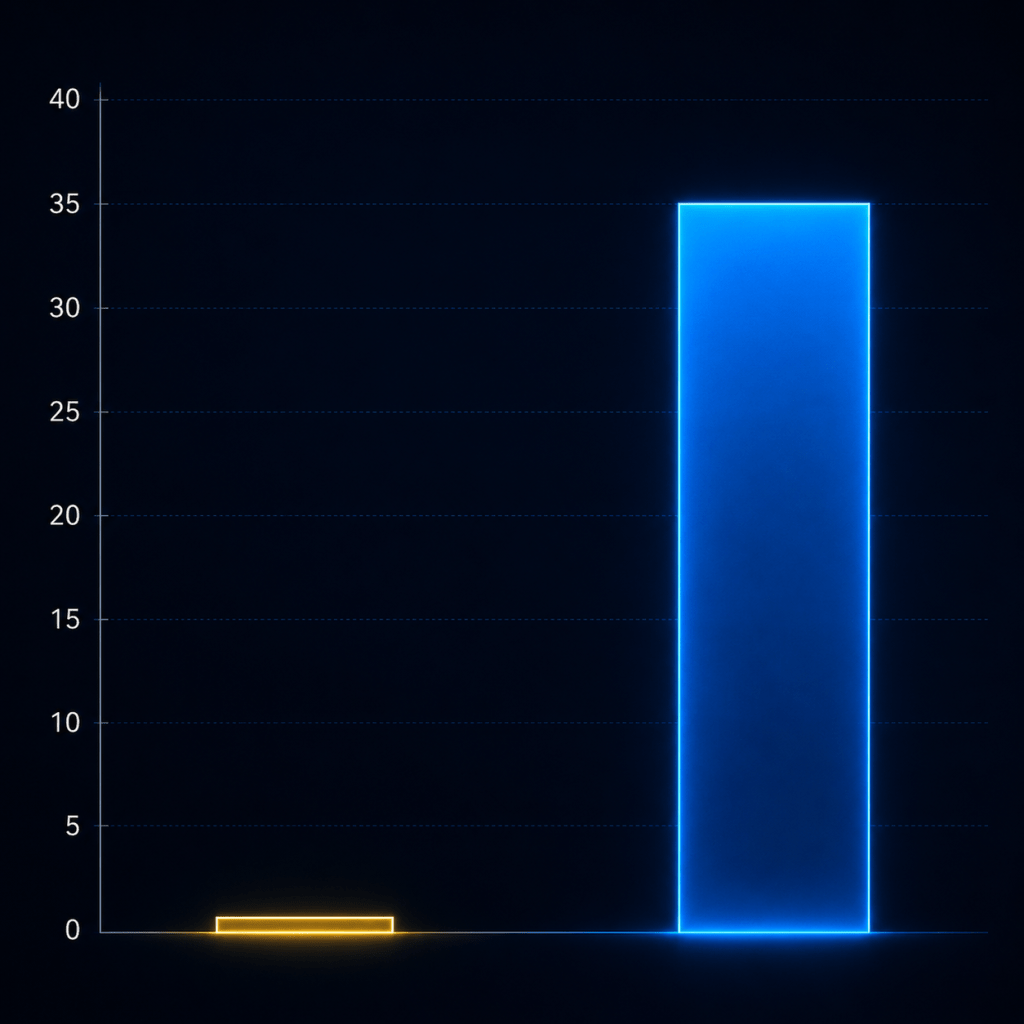
Valuation is where the quality story becomes actionable. At about $331, (INTU) trades near 12 times forward earnings and roughly 12 times free cash flow, an FCF yield north of 8%. For a business with 80% gross margins, high-teens returns on capital, and double-digit guided growth, that is a remarkable discount to its own history.
Run the cash flows backward and the message gets sharper. Treating stock-based compensation as the real economic cost it is, using a 9% discount rate that already bakes in AI and tax-disruption uncertainty, and a conservative 2.5% terminal growth rate, the current price implies the market expects roughly 1% annual free-cash-flow growth over the next five years. A company guiding 13% to 14% revenue growth this year does not need heroics to clear a 1% bar. It needs to keep growing through the transition.
Blended fair value lands near $480, conservative against both the most aggressive external estimates and a Street that, even after the quarter, still rates the stock a Buy with most targets clustered between roughly $375 and $605. A twelve-month target of $430 sits deliberately under fair value because sentiment does not repair on a straight line. Trapped holders, analysts still trimming targets, and momentum funds that will not touch a broken chart all slow the climb. Expect a messy recovery.
The technical read
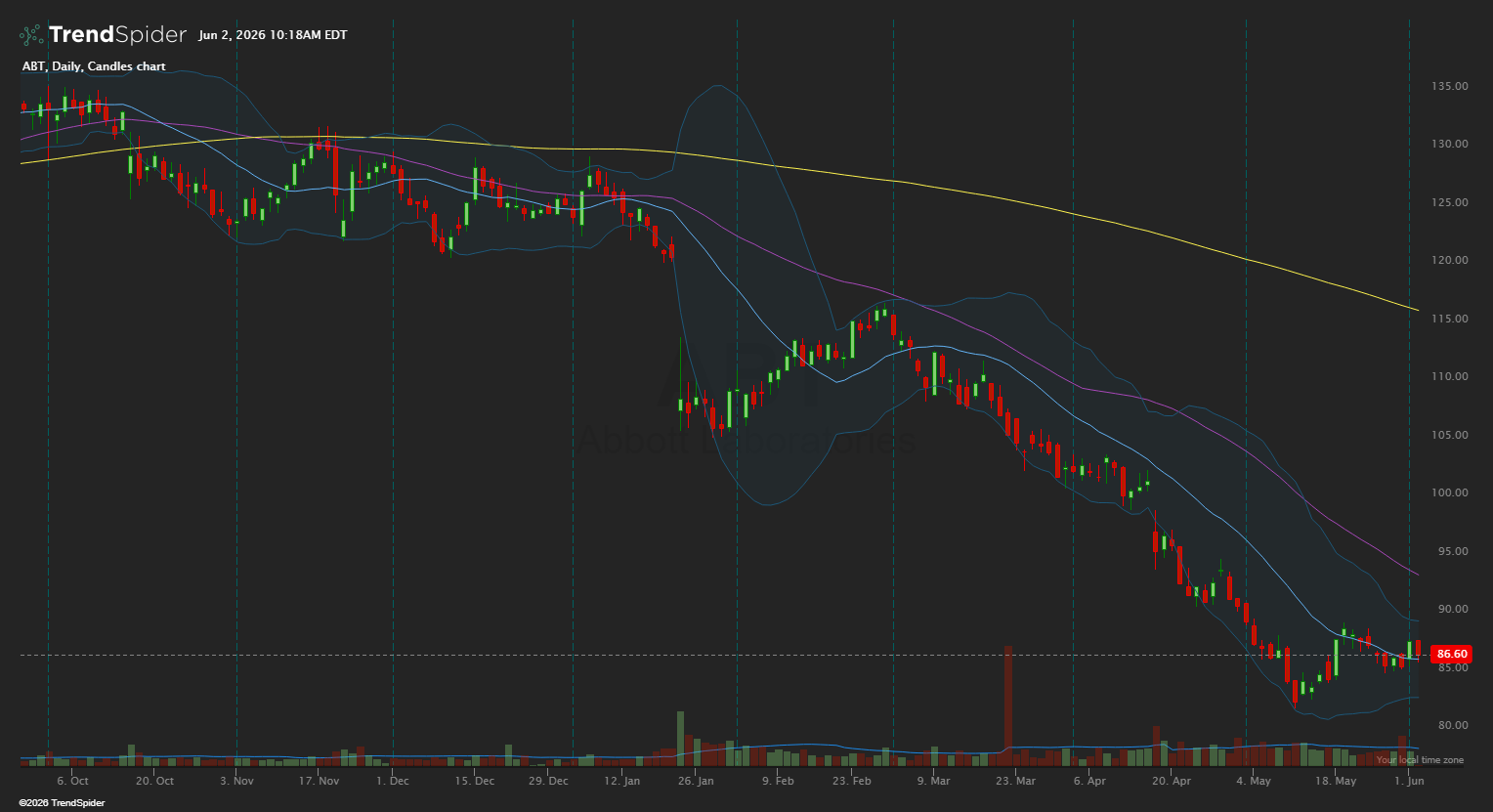
The chart confirms why patience beats a single lunge. Price remains far below both the 50-day near $397 and the down-sloping 200-day near $554. MACD is negative and below zero. On-balance volume is still weak, so there is no confirmed institutional accumulation yet. This is not a repaired uptrend.
What has changed is the character of the decline. Price flushed into the low $300s, bounced toward $331, and is trying to reclaim the lower Bollinger structure. Stochastics are deeply oversold and curling up. RSI sits in the low 30s and is carving a positive divergence against the May low, the green trendline visible on the lower panel. What shows up here is exhaustion, the moment the shaking starts to subside, well short of proof the ground has settled.
The zones that matter: immediate support at $315 to $320, major support and the panic low at $300 to $305, first resistance at $355 to $365, confirmation resistance at $385 to $405, and the long-term trend wall up at $500 to $555.
Comparison Table
| Ticker | Price | P/E | P/B | P/S | Mkt Cap | Fair Value | Disc. to FV | Margin | ROE | FCF Yield | Revenue | D/E |
|---|---|---|---|---|---|---|---|---|---|---|---|---|
| INTU | $353.76 | 15.35 | 4.73 | 4.67 | $97.6B | $866.69 | -59.18% | 21.90% | 22.50% | 7.90% | $20.9B | 0.30 |
| ADP | $233.74 | 21.82 | 14.81 | 4.35 | $94.0B | $289.74 | -19.33% | 20.10% | 71.20% | 5.48% | $21.6B | 0.63 |
| PAYC | $148.68 | 15.49 | 9.38 | 3.64 | $7.6B | $172.45 | -13.78% | 22.40% | 37.10% | 5.81% | $2.1B | 0.87 |
| FIS | $43.63 | 7.38 | 1.41 | 1.93 | $22.6B | $84.76 | -48.53% | 23.40% | 17.20% | 12.33% | $11.4B | 1.32 |
The bear who put a name on it
On June 2, a respected engineering firm walked the same building and stamped it condemned. Goldman Sachs cut (INTU) to Sell from Neutral and slashed its twelve-month target to $276 from $519, sending the stock down roughly 7% on the session. The lead analyst carries a top-decile track record, so this is not a throwaway call, and it deserves a straight answer rather than a dismissal.
Read the argument and it is the bear case this piece already named, now modeled in detail. Goldman’s worry is tax. TurboTax is roughly a quarter of revenue and operating income, and their base case has TurboTax revenue running about 18% below fiscal 2025 levels by 2030 if one in five US filers migrates to AI-only tools. They see the long-run growth algorithm shifting from a 14% historical pace toward 5% to 10%, and they reset their multiple accordingly. That is the same crack identified earlier, sized for a worse outcome and given an institutional signature.
Three things keep me on the other side of it. Start with what Goldman itself concedes: much of this is already in the price, Intuit has a two-decade history of adapting to technological change, and the company sees no AI market-share impact today, consistent with Goldman’s own channel checks. Their disagreement lives in a 2030 model, not in a 2026 fact. Then there is the shape of the Street. As of publication every other major shop still rates the stock a Buy, with post-quarter targets clustered from the high $300s to roughly $600, several of them five-star analysts sitting well above the current price. One Sell against that backdrop opens a genuine debate; it does not settle one. Most honest of all is the arithmetic of the target itself. Goldman’s $276 sits below my own $288 invalidation, which means they are effectively betting the stop-and-reassess line breaks. If they are right and price closes below $288 on heavy volume, my framework already tells me to step aside and re-underwrite the whole thesis. So the two views sit closer than the headline suggests. They split on whether the crack stays contained, and the next two prints answer that.
The risks, stated plainly
Five concerns deserve real weight. Narrative durability is the largest: if AI keeps eroding the tax-prep value proposition, TurboTax could earn a permanently lower terminal multiple. Stock-based compensation is a genuine economic cost that the Vulcan model deliberately subtracts from cash flow rather than ignores. Momentum is terrible, with the stock down 16% in a month and far below every key average, and weak momentum can trigger forced and tax-loss selling regardless of value. Execution risk on the restructuring is live until the savings actually show up in margins. And the technical structure is unrepaired, which means a third tranche should wait for confirmation rather than hope.
The invalidation line is specific. A weekly close below $288 on heavy volume is not an invitation to buy more cheaply. It is the signal to stop and inspect: did TurboTax erosion accelerate, did guidance get cut, did AI competition arrive faster than expected, did the retrofit create more disruption than savings? A lower price only helps if the structure is still standing.
The plan
You do not abandon a building because the seismograph screamed. You inspect the frame, and if it holds, you move in carefully, room by room. Here the foundation holds, the load-bearing walls are doing their job, and the one real crack runs through a single upper room, well above the base. So buy the first tranche near current levels where the valuation is plainly attractive, add a second on a defended retest of $300 to $315, and commit the final tranche only as price reclaims $365 and then $385 to $405. Keep the $288 weekly close as the line that ends accumulation and forces a fresh look.
The bottom line: the market repriced a high-quality, cash-rich compounder as if its moat had already failed, while the operating numbers still show a profitable business growing double digits with several engines beyond consumer tax. The stock broke before the business did. As long as the next few quarters confirm bending rather than breaking, this is weakness worth buying in stages.
Master Metrics Table
| Metric | Value |
|---|---|
| Price used (May 29 close) | $331.53 |
| Market cap | about $91.5B |
| Revenue TTM | $20.9B |
| FY26 revenue guide | $21.341B to $21.374B (+13% to 14%) |
| Forward P/E | about 12x |
| Price / FCF | about 12x |
| FCF yield | 8.4% |
| FCF margin | 36.9% |
| TTM free cash flow | $7.7B |
| Gross margin | about 80% |
| Net margin | about 22% |
| Operating margin (normalized) | high-20s% |
| ROIC | about 17.5% |
| Cash ROIC | 34.9% |
| Debt / equity | 0.30 |
| Interest coverage | 15x-plus |
| Altman Z | 4.93 |
| Piotroski F | 9 |
| Beneish M | -2.44 |
| Forward dividend | about $4.80 |
| Forward yield | 1.4% to 1.5% |
| Payout ratio | under 30% |
| Blended fair value | $480 |
| 12-month target | $430 |
| Margin of safety to FV | about 31% |
| Analyst consensus | Buy; targets mostly $375 to $605; lone Sell (Goldman) at $276 |
| Buy zone | at or below $432 |
| Strong Buy zone | at or below $384 |
| Very Strong Buy zone | at or below $336 |
| Ultra Value zone | at or below $288 |
| Trim review zone | at or above $528 |
| Invalidation | weekly close below $288 on heavy volume |
References
- Intuit Q3 FY26 earnings press release and full-year guidance, Intuit Investor Relations, May 20, 2026.
- Intuit Q3 FY26 Form 10-Q and restructuring disclosure, SEC, May 20, 2026.
- Intuit TurboTax forecast and 17% workforce reduction coverage, Reuters and Seeking Alpha, May 2026.
- Analyst target consensus and post-quarter revisions, MarketScreener and Benzinga, May 2026.
- Goldman Sachs downgrade to Sell, target cut to $276, and TurboTax 2030 scenario, Seeking Alpha and Investing.com, June 2, 2026.
- Analyst rank, success rate, and target spread, TipRanks, June 2026.
- Price and fundamentals reconciliation, GNG Research database and Vulcan Stock Research, June 1, 2026.


Leave a Reply