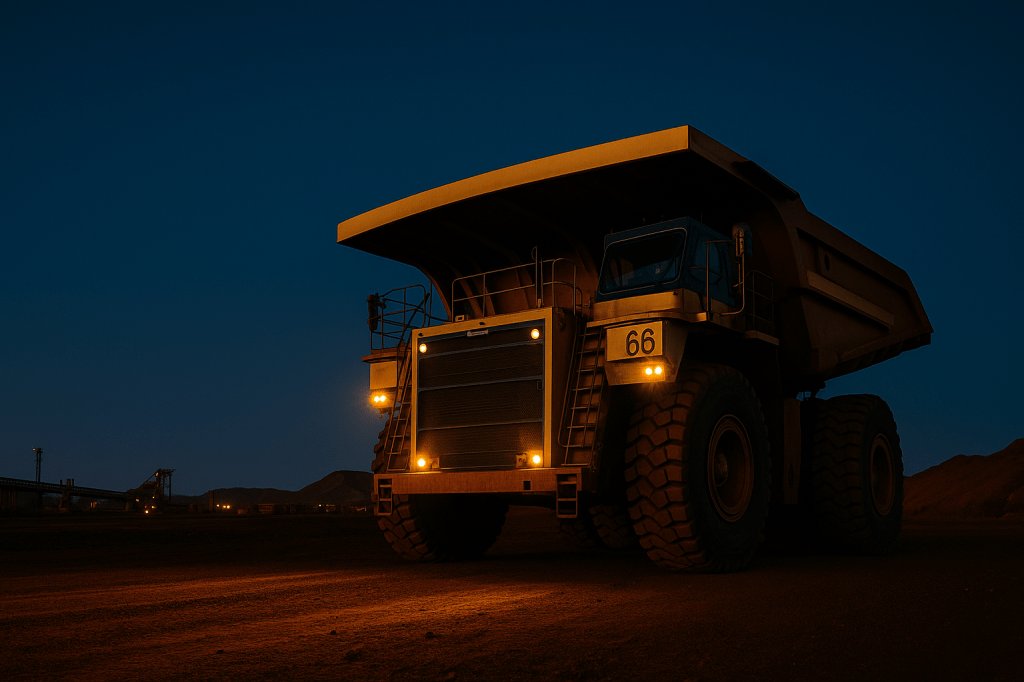
Picture this: somewhere in Western Australia’s Pilbara desert, a self-driving haul truck the size of a two-story house crawls along a dust-red road, carrying 290 tons of iron ore toward a port 400 kilometers away. It runs 24 hours a day, 365 days a year. No coffee breaks. No overtime pay. No sick days. That truck, and hundreds like it, help BHP Group earn roughly $70 million in profit every single day.
That’s the paradox of the world’s largest mining company. In a sector known for boom-bust drama and billion-dollar implosions, BHP has built something almost unheard of: a cash machine so reliable it’s actually dull. And for income investors searching for yield in a world where bonds pay next to nothing, “dull” might be exactly what you need.
The Pilbara Printing Press
To understand BHP, you first need to understand what happens when you control some of the cheapest iron ore on the planet. BHP’s Western Australia operations can dig ore out of the ground for roughly $15 per ton. When iron ore sells for $100, that’s an 85% gross margin. When it crashes to $60, they’re still pocketing $45. Most competitors would be bleeding red ink at those prices.
Think of it like owning the lowest-cost gas station on the interstate. Everyone else has to price above you to survive. You set the floor.
This cost advantage isn’t luck. It took $50 billion in infrastructure investment over decades: private railways, purpose-built ports, integrated power grids, and now those autonomous trucks that never sleep. Competitors can’t replicate this overnight. The Pilbara’s iron ore deposits are a geological gift, but the moat BHP built around them is pure engineering and capital discipline.
The numbers tell the story. In fiscal 2025, BHP generated $51.3 billion in revenue and kept $23.6 billion as EBITDA, a 46% margin that most tech companies would envy. Return on capital employed hit 20.6%, meaning every dollar BHP invests earns back twenty cents annually. That’s not growth-stock territory, but for a 170-year-old mining giant moving dirt, it’s exceptional.
Beyond Iron: The Copper Pivot
Here’s where the story gets interesting for the next decade. Iron ore built BHP’s fortress, but copper might determine its future.
The world needs copper for everything electric: vehicles, charging stations, solar panels, wind turbines, grid infrastructure. A single electric vehicle contains three times more copper than a gas-powered car. Data centers powering the AI boom are copper-hungry monsters. The International Energy Agency projects copper demand could double by 2040, yet major new mines take 15-20 years to develop.
BHP recognized this years ago and has been quietly assembling one of the planet’s best copper portfolios. The crown jewel is Escondida in Chile, the world’s largest copper mine, which BHP owns 57.5% of with Rio Tinto. They’ve added the massive Olympic Dam complex in South Australia and, through the 2023 OZ Minerals acquisition, gained additional copper and nickel assets.
The copper thesis is simple but powerful: structural supply deficits meet BHP’s operational excellence. In Q1 FY2026, BHP’s copper production grew 4% with record throughput at Escondida. Management guides toward 1,800-2,000 kilotons of annual copper production, positioning BHP as one of the few miners who can actually deliver the metal the energy transition needs.
The Potash Wild Card
BHP’s boldest bet sits 1,000 meters beneath the Saskatchewan prairie: the Jansen potash mine. When completed, it could become one of the world’s largest fertilizer operations.
Why potash? Simple math. Global population will approach 10 billion by 2050. Arable land isn’t growing. Soil degradation accelerates. Potassium fertilizer, potash, is essential for crop yields and virtually irreplaceable. The market has historically been controlled by a few producers in Belarus, Russia, and Canada, and recent geopolitical turmoil has made Western supply security a priority.
Jansen Phase 1 is 73% complete with first production expected in 2027. Phase 2 is already 13% underway. When fully operational, Jansen could add $1-2 billion in annual EBITDA, diversifying BHP beyond its China-dependent iron ore business.
The risk? Mining projects regularly blow budgets and timelines. Jansen has already seen cost creep. But if BHP executes, they’ll own a multi-generational asset producing a commodity the world literally cannot live without.
The Dividend Machine
For income investors, everything above matters primarily because it funds BHP’s dividend. And this is where BHP’s conservative management truly shines.
The company pays a minimum 50% of underlying earnings as dividends, but in practice often returns 55-60%. That flexibility is crucial. During the 2021-2022 commodity supercycle, BHP paid out over $6 per share including specials. In fiscal 2025, with earnings down 26%, they sensibly reduced the dividend to $1.10 per share. Painful for those expecting consistency, but far better than the alternative: overleveraging to maintain an unsustainable payout.
At today’s price near $56, that’s roughly a 3.5-4% yield. Not the highest in the sector, you can get 5-6% from Vale, but arguably the most secure. BHP’s balance sheet is a fortress: net debt of just $13.6 billion against $26 billion in EBITDA, a 0.5x leverage ratio. They have $17 billion in cash and short-term investments. Interest coverage exceeds 20x.
This matters because commodity cycles turn. They always do. When iron ore inevitably crashes again, BHP won’t be scrambling to cut dividends to service debt. They’ll trim payouts proportionally, weather the storm, and live to pay dividends for another 170 years.
The China Risk Nobody Can Ignore

I can’t write an honest analysis without addressing the elephant in the Pilbara: China accounts for roughly 60% of BHP’s revenue, almost entirely through iron ore purchases for steelmaking.
The bull case says Chinese steel demand, while maturing, remains enormous. Infrastructure spending continues. Urbanization isn’t complete. India and Southeast Asia are picking up slack.
The bear case is more troubling. Chinese steel production may have peaked. The property sector, historically consuming 40% of steel, remains in crisis. Beijing is actively pushing steel recycling and emissions reductions. The government recently floated steel production caps, which would directly hit iron ore demand.
Here’s what I actually think: both narratives contain truth, and neither changes the core thesis much. BHP’s cost advantage means they’ll be among the last producers standing in any scenario. They won’t produce as much iron ore at $60 as at $100, but they’ll remain profitable and dividend-paying. The copper pivot provides a hedge. And potash offers genuine China independence.
The risk is real but manageable. Position sizing should reflect it.
Five Risks That Keep Me Watching
1. China Hard Landing (30% probability, -40% impact): A severe Chinese recession or financial crisis would crater iron ore demand. BHP survives but dividends get slashed. Historical precedent: FY2016 when dividends fell 75%.
2. Commodity Super-Cycle Reversal (25% probability, -25% impact): Iron ore drifts toward $60-70 long-term as Chinese demand structurally declines and new supply from African projects like Simandou comes online. Earnings reset lower permanently.
3. Jansen Execution Failure (15% probability, -15% impact): Cost overruns and delays destroy the economic case for potash. BHP writes down billions. Not existential, but embarrassing and value-destroying.
4. Resource Nationalism (20% probability, -10% impact): Chile raises copper royalties further. Australia debates iron ore windfall taxes. These crimp margins but don’t threaten operations.
5. ESG Tail Risk (10% probability, -20% impact): Another Samarco-style disaster. UK lawsuits expand. License to operate becomes politically constrained. Low probability but severe if it materializes.
The Valuation Reality Check
Here’s where I have to be honest: BHP isn’t cheap. Trading at roughly 17x trailing earnings, the stock is fairly valued. DCF models suggest intrinsic value around $55-60 per ADR, right where we are today.
The stock has gained 13% year-to-date and sits near 52-week highs. Analyst price targets average $48, actually below current prices, reflecting cautious commodity forecasts. This isn’t a screaming buy on valuation alone.
But here’s my framework for thinking about it: BHP isn’t a growth stock. It’s a yield-plus-optionality play. The 3.5% dividend is real cash in your pocket. The copper and potash optionality is free. If China surprises positively or copper enters structural deficit, you participate. If commodities muddle along, you collect dividends and roughly match market returns.
How I’m Positioned
For full disclosure: I don’t currently own BHP, but it sits on my watchlist for the Vulcan Income portfolio.
My buy zones are as follows:
- Primary accumulation: Below $52 (10%+ discount to fair value)
- Strong buy: Below $45 (20%+ discount, backs up the truck)
- Current zone ($55-60): Hold if owned, initiate half-position if needed for diversification
Position sizing for a global income portfolio: 2-4% of total allocation. This isn’t a conviction overweight, it’s core income diversification with commodity exposure.
The invalidation trigger for the thesis: if copper expansion disappoints AND iron ore prices sustain below $70 for 12+ months AND management abandons capital discipline (raises debt to maintain dividends). Any two of those three signals a thesis review.
The Bottom Line
BHP Group is exactly what it looks like: the world’s most competent, most diversified, most conservatively managed mining company. It won’t double your money overnight. It won’t make you rich quick.
What it will do is generate reliable income through commodity cycles, provide portfolio diversification uncorrelated to tech and finance, and offer genuine optionality on copper and fertilizer demand for the energy transition.
In a portfolio context, BHP is the ballast. The steady hand. The cash cow that keeps paying while more exciting positions do their thing.
Sometimes boring is exactly what you need.
Master Metrics Table
| Metric | Value | Assessment |
|---|---|---|
| Current Price (ADR) | ~$56 | Near fair value |
| Market Cap | $150B | Mega-cap stability |
| Dividend Yield | 3.5-4.0% | Attractive for sector |
| Trailing P/E | 17x | Slight discount to market |
| Forward P/E | ~13.6x | Reasonable for cyclical |
| EV/EBITDA | 7x | Fair for quality assets |
| EBITDA Margin | 46% | Exceptional for mining |
| ROCE | 20.6% | Industry-leading |
| Net Debt/EBITDA | 0.5x | Fortress balance sheet |
| Piotroski F-Score | 7/9 (est.) | Strong fundamentals |
| Beta (3Y) | 0.7 | Lower volatility than market |
| 52-Week Range | $40-$60 | Near top of range |
| Primary Buy Zone | Below $52 | 10%+ margin of safety |
| Strong Buy Zone | Below $45 | 20%+ margin of safety |
| Thesis Invalidation | Iron <$70 sustained + copper disappointment + debt increase |
Data as of December 2025. Do your own due diligence.

 Vulcan Stock Research
Leave a comment