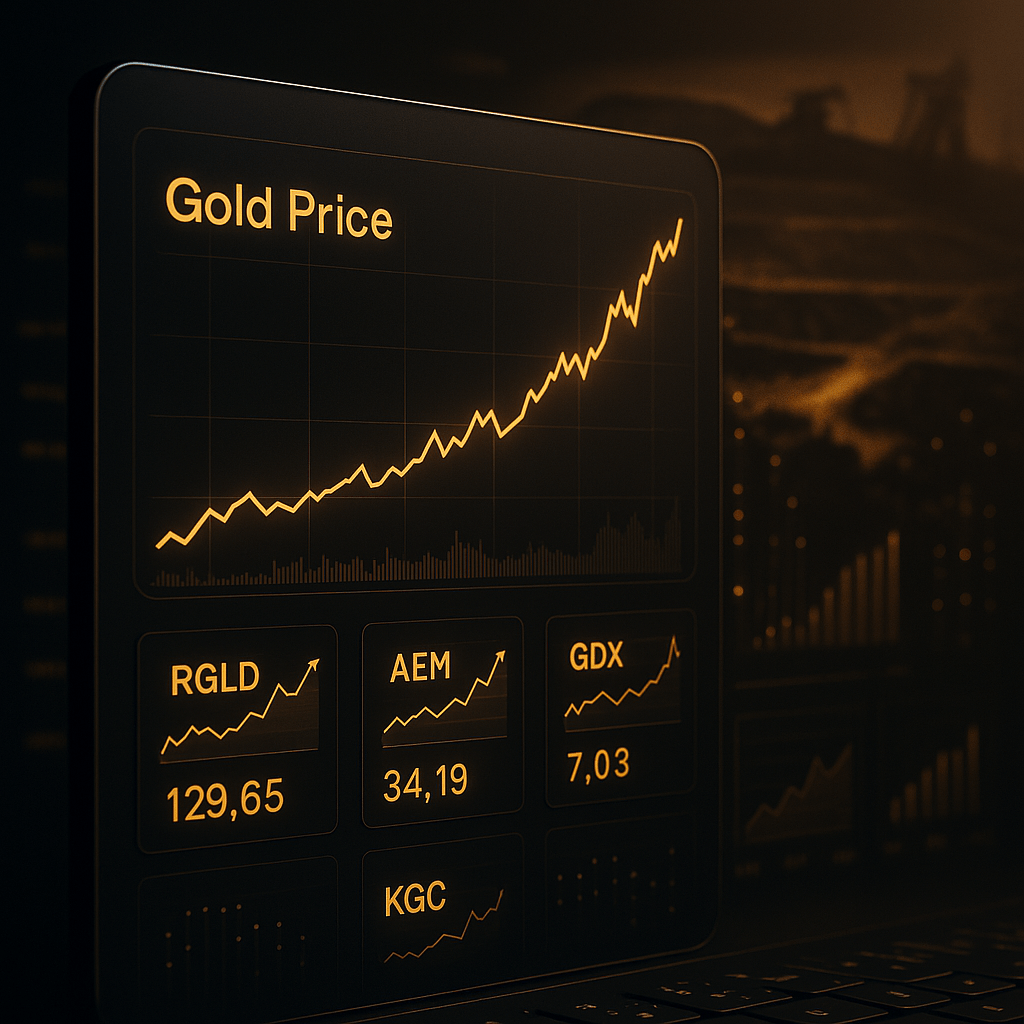
The investment world has shifted dramatically. While retail investors chase the latest meme stock or cryptocurrency flash crash, institutional money is quietly building fortress-like positions in an asset class that’s been delivering steady returns for centuries: gold mining stocks.
But this isn’t your grandfather’s gold rush. The modern precious metals landscape has evolved into a sophisticated ecosystem where strategic positioning can deliver both defensive protection and explosive upside. The Vulcan-mk5 analytical model has identified a powerful four-stock sleeve that captures this opportunity: Royal Gold (RGLD), Agnico Eagle Mines (AEM), VanEck Gold Miners ETF (GDX), and Kinross Gold (KGC).
This isn’t about burying gold coins in your backyard or betting on economic collapse. This is about recognizing that gold has transformed from a doomsday hedge into a mainstream portfolio cornerstone—and positioning yourself to profit from that transformation.
The Golden Transformation: Why Now Is Different
For decades, gold stocks carried the stigma of speculation and doom-and-gloom investing. That narrative is dead. Today’s gold market operates under entirely different fundamentals that make it attractive to growth investors, income seekers, and defensive strategists alike.
Central banks worldwide are accumulating gold at the fastest pace since the 1970s. This isn’t happening because they fear the end of the world—it’s happening because they recognize gold’s role in a multipolar financial system where no single currency dominates. Countries from China to India to Brazil are diversifying their reserves, creating sustained institutional demand that didn’t exist during previous gold cycles.
Mining companies have learned hard lessons about capital discipline. Gone are the days of debt-fueled expansion into risky jurisdictions. Today’s major miners prioritize shareholder returns through dividends and buybacks over pie-in-the-sky growth projects. This fundamental shift has transformed the risk-reward profile of the entire sector.
Gold has broken its historical correlation patterns. Traditional wisdom suggested gold fell when real interest rates rose. That relationship has weakened significantly, with gold appreciating even as rates remain positive. This decoupling suggests gold is pricing in factors beyond monetary policy—geopolitical risk, currency debasement, and structural shifts in the global financial system.
The Four-Pillar Strategy: Building Your Golden Foundation
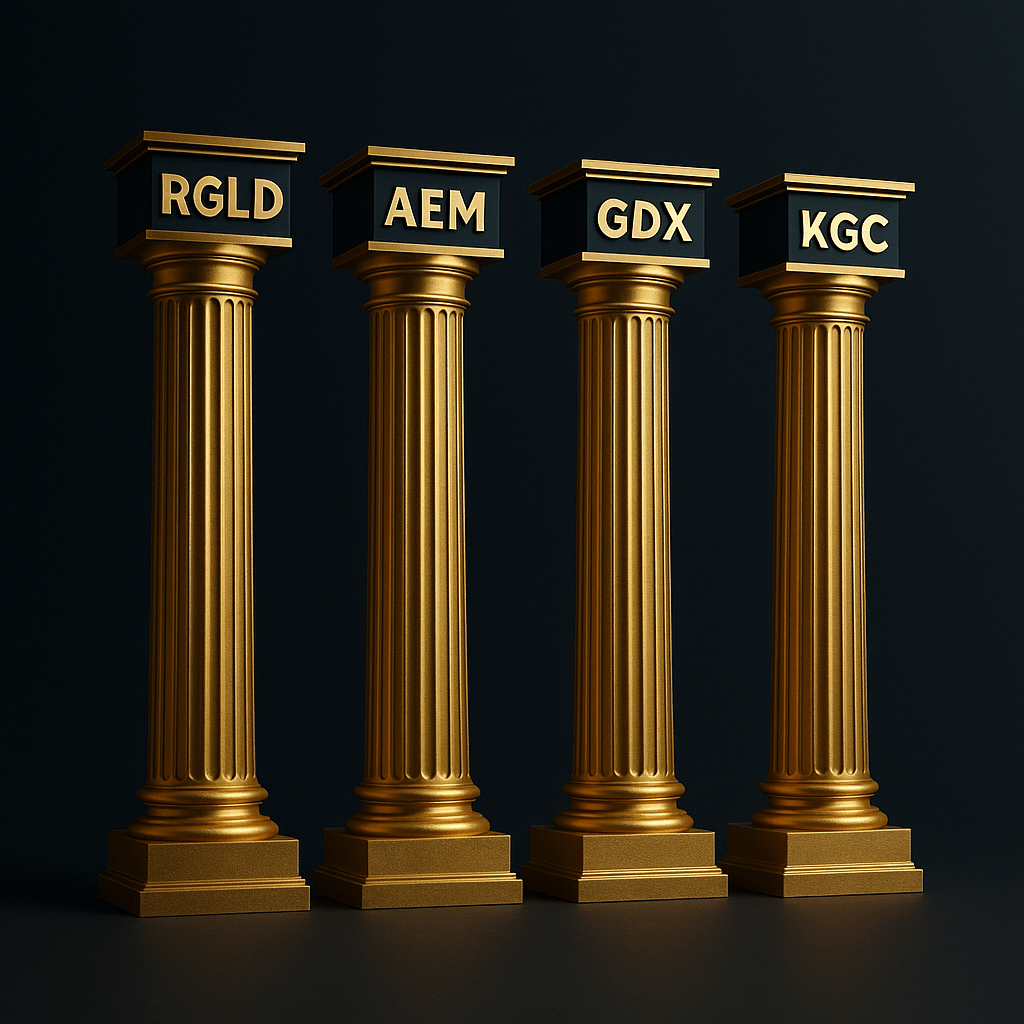
The beauty of this curated sleeve lies not in picking one winner, but in creating a balanced ecosystem where each holding serves a specific strategic purpose. Think of it as building a diversified business portfolio within the precious metals space.
Royal Gold (RGLD): The Cash Flow Machine
Allocation: 3.0% of portfolio
Royal Gold represents the pinnacle of business model evolution in the mining sector. As a royalty and streaming company, RGLD doesn’t operate mines, hire miners, or deal with environmental permits. Instead, they provide upfront capital to mining companies in exchange for the right to purchase a percentage of future production at below-market prices.
This creates a magical combination: 85%+ gross margins with zero operational risk. When gold prices rise, RGLD captures the upside through higher royalty payments. When mining costs inflate, RGLD’s margins remain protected because they’re not paying those costs. It’s like owning a piece of every major mine without any of the headaches.
RGLD’s portfolio spans tier-one jurisdictions including Canada, Nevada, and Australia—politically stable regions where property rights are respected and regulatory frameworks are predictable. With over 190 royalties across 30+ properties, the company has built a diversified income stream that generates predictable cash flows regardless of any single mine’s performance.
For retail investors, RGLD offers something rare in today’s market: a growing dividend backed by real assets and contractual cash flows. While tech stocks promise future profits, RGLD delivers actual dividends from actual gold production happening right now.
Agnico Eagle Mines (AEM): The Blue-Chip Producer
Allocation: 2.5% of portfolio
If Royal Gold is the landlord of the gold world, Agnico Eagle Mines is the reliable tenant who always pays rent on time. As a top-three global gold producer, AEM has built its reputation on operational excellence in low-risk jurisdictions.
AEM’s secret weapon is geography. While many miners chase lower-cost deposits in unstable regions, AEM has focused on building long-life mines in Canada and Finland—countries where the biggest political risk is a change in tax rates, not nationalization or civil war.
This geographic focus translates into financial performance. AEM maintains some of the lowest all-in sustaining costs (AISC) in the industry, a crucial metric that determines profitability across different gold price environments. Low costs mean high margins, and high margins mean the ability to maintain dividends even during commodity downturns.
The company’s dividend yield above 3% makes it attractive to income investors, while its strong balance sheet and 15+ year reserve life provide the stability that growth investors seek. AEM isn’t going to triple overnight, but it’s the kind of fortress asset that can anchor a portfolio through various market cycles.
VanEck Gold Miners ETF (GDX): The Sector Amplifier
Allocation: 2.0% of portfolio
Sometimes the smartest investment strategy is admitting you can’t predict every winner. GDX solves this problem by providing instant diversification across the entire large-cap gold mining sector, while maintaining the liquidity and transparency that retail investors need.
GDX isn’t just a random collection of mining stocks—it’s a carefully weighted basket that emphasizes the sector’s highest-quality names. The ETF automatically rebalances to maintain exposure to the best-performing companies while reducing allocation to underperformers. This built-in optimization removes the burden of constant portfolio management from individual investors.
In this strategic sleeve, GDX serves two critical functions. First, it provides diversification insurance against individual stock volatility. If RGLD faces a specific corporate challenge or KGC hits operational problems, GDX’s broad exposure cushions the portfolio’s overall performance.
Second, GDX acts as a sector beta amplifier. If gold enters a sustained bull market, GDX’s diversified exposure ensures you capture the broad-based gains that occur when institutional money floods into the sector. Historical data shows that during gold bull markets, the miners tend to outperform the underlying metal by 200-300%, and GDX is positioned to capture that leverage.
Kinross Gold (KGC): The Turnaround Story
Allocation: 1.5% of portfolio
Every strategic portfolio needs an asymmetric bet—a position where limited downside risk comes with unlimited upside potential. Kinross Gold fills that role perfectly.
Five years ago, Kinross was a cautionary tale of poor capital allocation and operational mishaps. The company had expanded into risky jurisdictions, taken on excessive debt, and consistently disappointed shareholders with cost overruns and production shortfalls.
Today’s Kinross is a different company. Management has systematically divested high-risk assets, focusing operations on stable jurisdictions with predictable regulatory environments. They’ve improved operational efficiency, reduced debt levels, and begun generating substantial free cash flows.
The transformation shows up in the valuation metrics. KGC trades at an EV/EBITDA multiple below 6x and a price-to-net asset value discount exceeding 25%. These metrics suggest the market hasn’t yet recognized the company’s operational improvements, creating an opportunity for patient investors.
KGC represents the highest-risk, highest-reward component of this sleeve. It’s sized appropriately at 1.5% to limit downside while providing meaningful upside participation if the turnaround thesis plays out.
The Macro Tailwinds: Why Gold’s Time Has Come
The investment case for gold miners extends far beyond company-specific fundamentals. A convergence of macroeconomic factors has created the most favorable environment for precious metals in decades.
Interest rate dynamics are shifting in gold’s favor. While conventional wisdom suggests rising rates hurt gold, the relationship is more nuanced. What matters is real rates—nominal rates minus inflation. With inflation proving stickier than central banks anticipated and rate hike cycles potentially nearing their peak, real rates may have already hit their ceiling. Historically, gold performs best during falling or stable real rate environments.
Currency debasement concerns are accelerating. The U.S. national debt has breached $36 trillion and continues growing at an unsustainable pace. Modern Monetary Theory may sound sophisticated, but it’s really just an academic justification for printing money to solve fiscal problems. As this reality becomes undeniable, investors seek assets that maintain purchasing power independent of any single government’s fiscal discipline.
Geopolitical fragmentation is driving reserve diversification. The weaponization of dollar-based sanctions has accelerated the search for alternatives among non-aligned nations. BRICS+ countries are actively reducing dollar reserves in favor of gold, creating sustained institutional demand that didn’t exist during previous commodity cycles.
Supply constraints are tightening. Major gold discoveries have become increasingly rare, and the lead time from discovery to production continues extending. This supply-side limitation provides a natural floor under gold prices, especially when combined with rising institutional demand.
Portfolio Integration: Building Your Golden Sleeve
This four-stock sleeve is designed to function as a complete precious metals allocation within a broader diversified portfolio. The recommended 5-10% total allocation strikes the right balance between meaningful upside participation and prudent risk management.
The position sizing reflects each holding’s risk-reward profile and strategic purpose. RGLD receives the largest allocation because its business model provides the best combination of growth potential and defensive characteristics. AEM gets the second-largest allocation as the blue-chip anchor that provides stability and income. GDX receives moderate allocation to ensure broad sector exposure and liquidity. KGC gets the smallest allocation because it’s the highest-risk, highest-reward component.
This structure creates natural portfolio balance across different market environments. During inflationary periods, the miners can outperform traditional defensive assets like bonds. During equity market stress, the royalty model of RGLD often provides better downside protection than cyclical stocks. During gold bull markets, the operational leverage in AEM, GDX, and KGC can deliver returns that exceed the underlying metal’s performance by significant margins.
Historical analysis shows that across the last five major gold bull markets, miners have outperformed bullion by an average of 220%. This operational leverage explains why building a thoughtful mining sleeve can be more effective than simply buying gold ETFs or physical metal.
Risk Management: What Could Go Wrong
No investment thesis is complete without honest risk assessment. Gold miners face several potential headwinds that could impact returns.
Input cost inflation represents the most immediate operational risk. Mining is energy and labor intensive, and inflation in these inputs can rapidly erode margins. However, this risk is largely mitigated through the sleeve’s construction—RGLD has no direct operational exposure, AEM maintains low-cost operations, and GDX’s diversification reduces single-company risk.
Gold price volatility remains the sector’s primary systematic risk. All gold miners are ultimately leveraged bets on the underlying commodity price. However, the companies in this sleeve have been selected for their ability to generate positive cash flows even at moderate gold prices, reducing vulnerability to short-term volatility.
Jurisdictional risks vary across holdings. While RGLD and AEM focus on stable jurisdictions, GDX includes companies with emerging market exposure, and KGC’s improvement story includes exposure to less predictable regulatory environments. This geographic diversification actually reduces overall portfolio risk by avoiding concentration in any single political system.
ESG regulatory changes could impact operating costs. Environmental regulations are tightening globally, potentially requiring additional compliance investments. However, this trend favors larger, well-capitalized miners that can absorb these costs while smaller competitors struggle—a dynamic that benefits the companies in this sleeve.
The Implementation Blueprint
Building this golden sleeve requires discipline and patience. These positions are designed as strategic allocations, not trading positions. The goal is building wealth over years and decades, not capturing quick profits from gold price fluctuations.
Start with RGLD and AEM as your foundation—these are the positions that provide stability and predictable returns. Add GDX for broad sector exposure and liquidity. Finally, layer in KGC as your asymmetric bet on sector recovery and gold price appreciation.
Rebalancing should be infrequent and methodical. If any single position grows to represent significantly more than its target allocation due to outperformance, consider trimming to maintain portfolio balance. Conversely, if strong performance in gold drives all positions higher, resist the temptation to add more—stick to your allocation discipline.
Conclusion: Your Golden Opportunity
The opportunity in gold miners isn’t about timing the next crash or predicting currency collapse. It’s about recognizing a structural shift in how institutions and governments view precious metals in a multipolar world. Central banks are buying, governments are diversifying reserves, and mining companies have learned to prioritize shareholders over empire-building.
This four-stock sleeve—RGLD, AEM, GDX, and KGC—captures that opportunity through a balanced approach that emphasizes quality, diversification, and asymmetric upside potential. With 5-10% of your portfolio allocated across these positions, you’re positioned to benefit from gold’s ongoing transformation from fringe hedge to mainstream asset.
The smart money is already positioning. The question isn’t whether gold miners will outperform in the coming cycle—it’s whether you’ll be positioned to participate when they do.
Let the market dig. You collect the wealth.
References and Further Reading
- World Gold Council: Central Bank Gold Reserves Statistics
- Company 10-K filings: RGLD, AEM, KGC annual reports
- VanEck GDX Holdings and Performance Data
- Federal Reserve Economic Data (FRED): Real Interest Rates
- IMF Global Financial Stability Reports
Vulcan-mk5 Master Metrics
Position Allocation Guidelines
| Security | Symbol | Allocation | Role | Risk Profile |
|---|---|---|---|---|
| Royal Gold | RGLD | 3.0% | Royalty income stream, zero operational drag | Low |
| Agnico Eagle Mines | AEM | 2.5% | Tier-1 low-cost producer with yield | Low-Medium |
| VanEck Gold Miners ETF | GDX | 2.0% | Broad sector exposure, liquidity access | Medium |
| Kinross Gold | KGC | 1.5% | Undervalued high-torque upside | Medium-High |
| Total Allocation | 9.0% | Complete precious metals sleeve | Balanced |
Key Performance Metrics
| Metric | RGLD | AEM | GDX | KGC |
|---|---|---|---|---|
| Gross Margins | 85%+ | 35-40% | Varies | 25-30% |
| Dividend Yield | 1.2% | 3%+ | 1.8% | Variable |
| All-in Sustaining Costs | N/A | <$1,100/oz | Varies | ~$1,200/oz |
| Reserve Life | 15+ years | 15+ years | Varies | 8-10 years |
| Geographic Risk | Very Low | Very Low | Medium | Medium |
Strategic Implementation Framework
- Initial Build Period: 3-6 months dollar-cost averaging
- Rebalancing Frequency: Semi-annual or when positions drift >25% from target
- Review Cycle: Quarterly fundamental analysis, annual strategic assessment
- Exit Triggers: Major thesis breakdown, sustained underperformance vs. sector
- Upside Targets: 2-3x gold price performance during bull markets


 Vulcan Stock Research
Leave a reply to Kinross Gold (KGC): Mining Gold While Others Panic – Vulcan Stock Research Cancel reply